


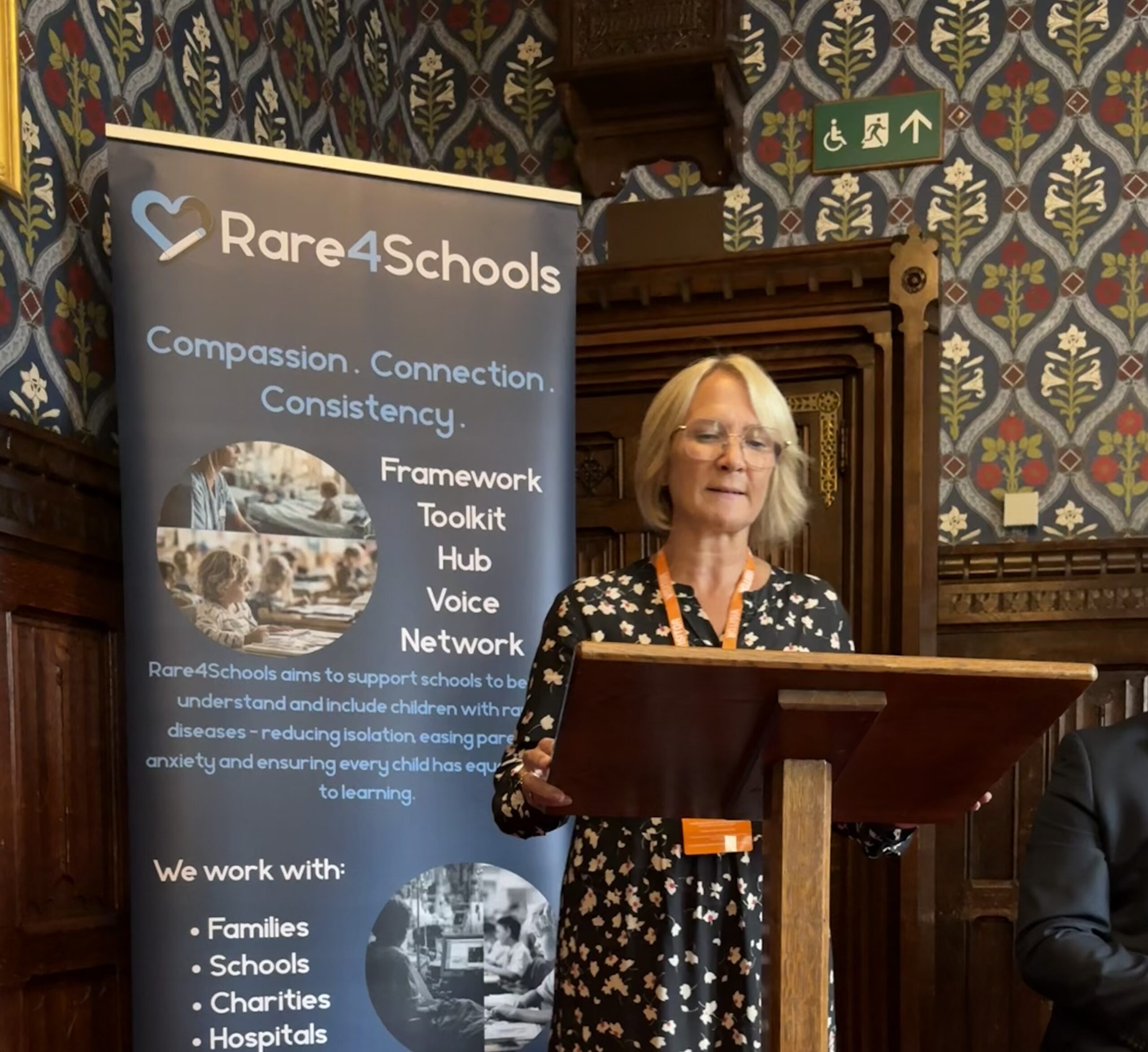
Our CEO, Lauren Roberts, and Senior Counsellor, Rebecca Hargreaves, recently attended the Rare4Schools event in Parliament, bringing together policymakers, parliamentarians and organisations from across the rare condition community.
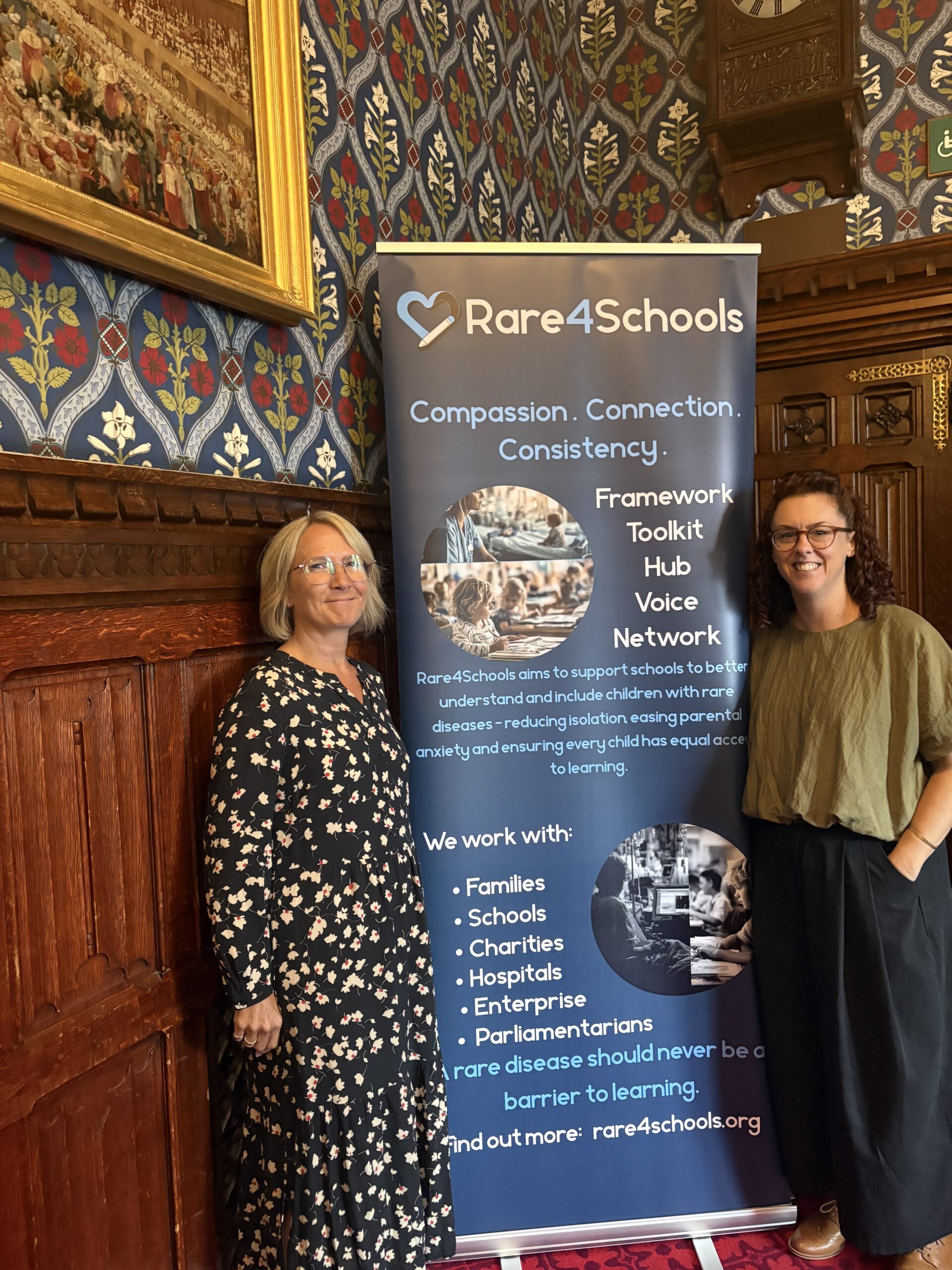
Rareminds is proud to support the work of Rare4Schools, alongside Medics for Rare Disease, camRARE and Intent Health. Through our counselling work with the rare condition community, we see the emotional impact on children, siblings and parents when education needs are not understood or met, and we know how much difference compassion, communication and consistency in schools can make.
Rebecca was invited to speak at the event, sharing insights from our clinical services on what it means for a child to go to school carrying a condition most people around them do not understand, and why families need to be seen holistically and supported consistently. Her speech is shared in full below.
Rebecca’s Speech
I’m Rebecca, one of the Senior Counsellors from Rareminds. We are a charity providing specialist mental health services to people impacted by rare conditions. We currently work in partnership with 26 rare condition charities to provide specialist counselling. Since 2020 we have provided over 4000 counselling sessions to individuals and couples.
I’m here today to share some of the insights from our clinical services about the significant impact that failures to support the education needs of children with rare conditions has on the child, their family and wider support network. Families need to be seen holistically and supported consistently.
I want to begin by asking you to imagine what it might be like to be a child who is required to go to school carrying something that most of the people around them do not understand.
Perhaps they have a rare condition that causes pain, fatigue, seizures, hospital admissions, physical differences or an uncertain prognosis. Perhaps they know that their body cannot always be trusted. Perhaps they have already experienced loss — of health, of independence, of friendships, or of the future they once imagined for themselves. And alongside that child is often a mother, father or guardian, carrying an enormous emotional burden.
For many parent of children with rare conditions, there is a particular kind of grief. It is grief for the child they imagined they would have, and for the future they had imagined for their family and for the mother they imagined they would be for that child. The first diagnosis can change that imagined future overnight
The birthday parties, school achievements, university, independence, relationships, employment — all the ordinary milestones that parents naturally imagine for their children — can suddenly feel, at least, uncertain, complex or sometimes impossible.
Some may be living with the knowledge that they will have a shortened life expectancy so there might not be a future.
Despite all this, there is still an expectation that the child goes to school or into education in some form.
This is where I believe we need to think differently. Because school is not simply a place where children learn academic subjects. School, alongside home, is where children can develop a sense of who they are, where they belong, and what they might become. For a child living with a rare condition, that sense of possibility can be particularly fragile.
A child may be absent because they are in hospital. They may be exhausted and unable to concentrate. They may need medication during the school day. They may miss lessons, trips, exams or social events. They may look different from their peers. They may worry about having a medical episode in front of their classmates. Sometimes the greatest difficulty is not the curriculum itself, but the feeling of being different.
Children can become very skilled at hiding their difficulties. They may not ask for help because they do not want to be seen as different. They may push themselves beyond what their bodies can manage because they desperately want to be like everyone else whilst their parents may be constantly negotiating between protecting their child and allowing them to experience an ordinary childhood.
A child may be well one week and profoundly affected the next. Attendance and attainment cannot always be understood through a simple measure of absence or exam results. Teachers cannot be expected to become medical experts, but they could understand the emotional and educational consequences of living with a serious and unpredictable condition. Flexible attendance, access to rest, adaptations to workload, remote learning where appropriate, and flexibility around examinations and assessment could make a significant difference.
And we must not forget the siblings. Imagine leaving for school as your parent was resuscitating your brother or sister because they had a serious seizure. Imagine sitting in class knowing an ambulance was called but not knowing if they are ok or not. We need to support the emotional lives of these children. Access to counselling and psychologically informed support should not be seen as an optional extra. Children need somewhere to talk about fear, anger, difference, uncertainty and grief.
We also need to recognise the profound impact on parents and guardians. Parents and in particular mothers, can find themselves becoming advocates, carers, researchers, administrators and emotional containers for the whole family. Their exhaustion and grief can easily become invisible. This impacts not just their own mental wellbeing, but their ability to support their family. Schools need to recognise parents as partners, not simply as people who need to be contacted when something goes wrong.
Most importantly, we need to work with the family to find a realistic, reimagined future. A diagnosis should change what we understand about a child’s needs, but it should not automatically reduce what we imagine is possible for them. Equally vital however, is that a fantasy future is not displayed as possible if it is not. This can leave the child feeling like they have failed rather than being given realistic possibilities.
Children living with rare conditions need adults around them who can hold hope alongside realism.
They need teachers who can say, ‘we may need to do things differently, but we still believe you can learn, participate, develop and have a future’.
Schools need to understand that grief and hope can exist together and they need policymakers to recognise that educational equality does not always mean giving every child the same thing. Equality should mean giving a child exactly what they need to have the same opportunity to learn, belong and imagine a future.
For a child living with a rare condition, their education may be the most important opportunity they have, providing not simply teaching but educating them to live with what their condition may have taken away, whilst helping them discover what might still be possible.
About Rare 4 Schools
Rare4Schools exists to ensure that a rare disease is never a barrier to learning. There are approximately 2.7 million children and young people in the UK living with a rare disease, yet they remain largely absent from education policy and too often invisible in day-to-day school life. The event called on policymakers to bring rare disease and education policy together, setting out five practical asks: implementing the Rare4Schools framework, rolling out a rare disease passport in schools, including teachers and SENDCo teams in multi-disciplinary teams, funding rare disease training for SEN leads, and strengthening individual support plans under SEN reform. You can find out more about Rare4Schools here.