

Rare Minds Matter: 2023 Mental Health & Rare Conditions Survey
The ‘Rare Minds Matter – 2023 Mental Health Survey’ report explored the post-pandemic mental health experiences of the UK’s rare community, shedding light on an often overlooked aspect of living with a rare condition.
With 695 respondents representing over 188 rare conditions, our survey reveals the significant impact rare conditions have on the mental health and wellbeing of affected individuals, carers, family members, and frontline staff and volunteers providing support.
The biggest challenges identified were:
- Worrying about the future
- Fatigue
- Lack of awareness among healthcare professionals
- Managing uncertainty
- Anxiety
One size will not ‘fit all’ in terms of support for rare mental health and wellbeing. Different types of support will be needed at different times.
Better collaboration across medical and mental health services sectors, and the third sector (including rare condition organisations) is needed. This integrated support, alongside psychologically informed ‘rare-aware’ care, is fundamental to supporting the mental health and wellbeing needs of the rare community.
Survey Results
Key findings
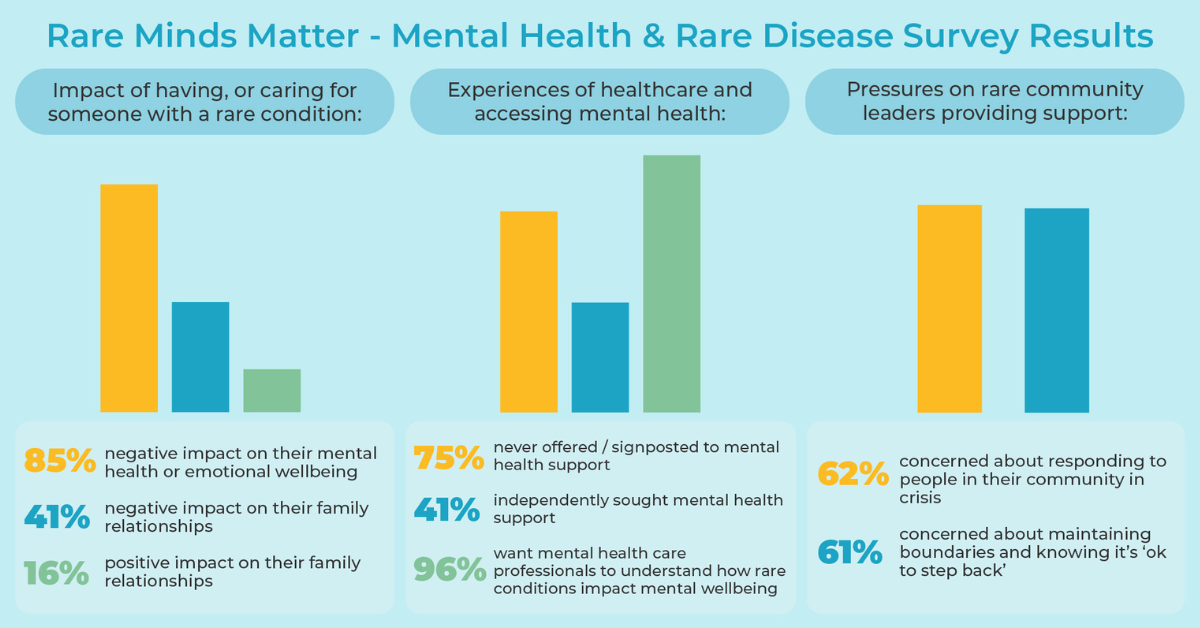
Living with a rare condition creates additional and particular challenges for mental health & wellbeing.
Rare conditions can affect the protective function usually played by family and couple relationships to support mental health & wellbeing.
Relationships and interactions with healthcare professionals have a significant impact on the mental health & wellbeing of people affected by rare conditions.
Mental health support is desirable, but accessing appropriate services is not always easy.
The level of mental health support provided by rare condition group leaders can impact their own mental health & wellbeing.
Recommendations:
A holistic, integrated approach to rare care that includes consideration of mental and emotional wellbeing is essential.
Support is needed to help manage the impact of rare conditions on the dynamics of personal relationships.
Anyone impacted by a rare condition should receive psychologically-informed ‘rare aware’ care from the healthcare professionals they encounter.
Training is required for the existing mental health workforce on the impact of rare conditions on mental health and wellbeing.
Lived experience and third sector support for mental health & wellbeing should not be seen as a replacement for statutory provision.
Ongoing support & training for rare leaders and peer-to-peer supporters is needed to safeguard their mental wellbeing.