


Managing tiredness, exhaustion and fatigue
Practical tools to manage fatigue including activity scheduling, pacing and spoon theory

Coping with fatigue with Jess Hobart from The UK Mastocytosis Support Group
Activities schedules: Managing your energy levels
Depending on the nature and impact of the rare condition you or the person you care for are affected by, planning your time may feel difficult.
That might be because of the impact of health crises, variable energy, factors outside your control, and how much time it takes to do any one activity for you or them as an individual.
Scheduling and planning can help you:
- feel more in control
- feel less overwhelmed
- manage stress (and distress)
- notice what gets ‘left off or out’
- become more strategic (and possibly ruthless!) about your own time management and needs
They can be useful to use alongside Spoon Theory.
Making an activities schedule
Start with a list of daily, weekly and monthly tasks or activities that you need to do for yourself and/or the person you care for.
Some ideas what to include:
Morning
- Getting up and washing etc
- Breakfasting
- Getting dressed
- Supporting others as above
- Exercises or physio (self/other)
- Resting or breaks
Daytime
- Buying food
- Preparing food
- Cleaning
- Cooking
- Dropping of / picking up family members
- Supporting someone else (and in what way)
- Life admin
- Work
- Hobbies or activities
- Pets
Evening
- Talking to friends/ family member
- Cooking
- Eating
- Washing
- Getting ready for, and into bed
- Reading
- Taking medication
- Exercises or physio
- Watching TV, social medic etc
- Hobbies or activities

Therapist tip
Build in time-slots for rest, pleasure, fun and other related needs. These often get missed off, or de-prioritised. Be kind to yourself in the face of competing demands and difficult choices.
Revise your schedule as needed both daily and weekly.
For example if you (or someone you care for) had a health crisis yesterday, you might have been unable to have time to do some things you had planned.
Make conscious decisions as to what:
- can wait (and until when)
- no longer needs doing (the moment has passed)
- what you choose to ‘let go’ and not do
- what is important to make time for
- where to make time for what’s got lost (perhaps by dropping or postponing another activity)
Activity Schedules are not an exact science, but they can help you start to manage your energy (and time) differently.
Spoon Theory
Spoon Theory is a way of thinking about how much energy you have in reality – and how to ‘spend it wisely.’
It was first coined as a term by Christine Miserandino, who has lupus, as a way for people impacted by chronic illness to communicate their limited energy levels.
Life is complicated, so Spoon Theory is not an ‘exact science’. However, we all only have ‘so much energy’ and it can help you to hold this in mind and make time where possible to rest, recover – or not try to always ‘do it all’ (or as much you would like).
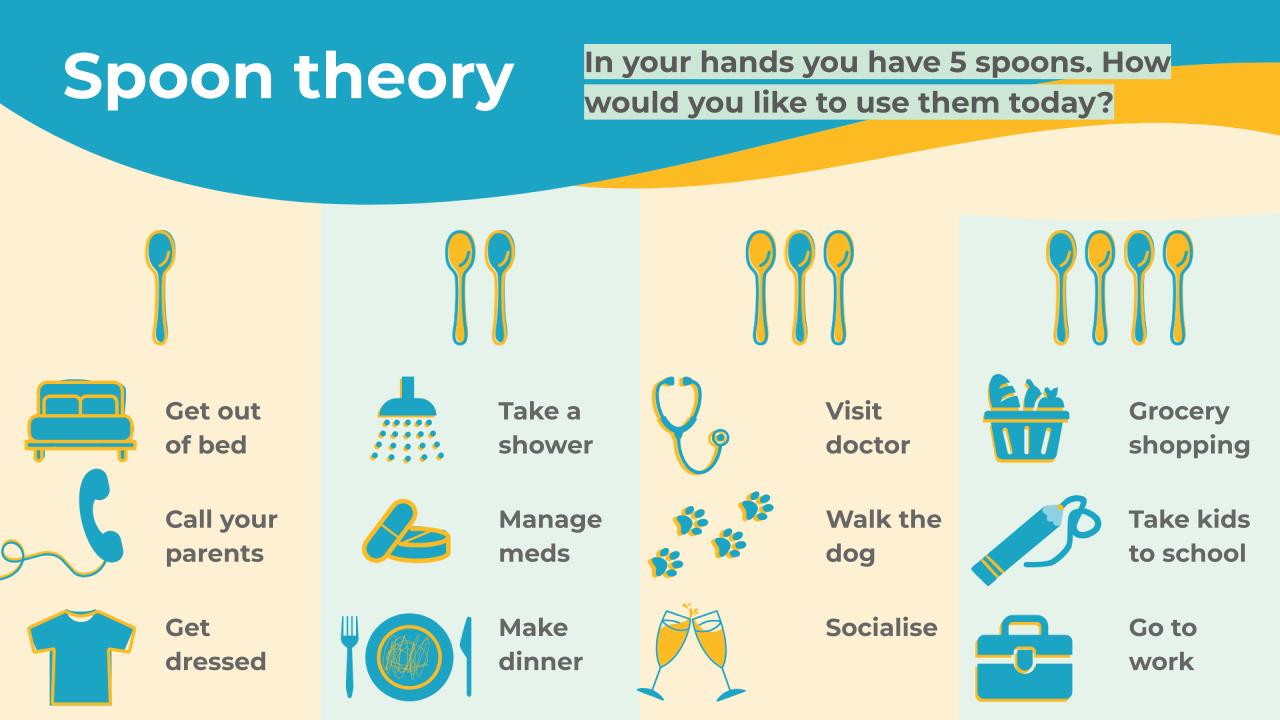
How Spoon Theory works:
Imagine you have a jar of energy, and a teaspoon.
You are allowed to take out 5 teaspoons of energy from your jar each day. This is your daily ‘energy allowance.’
Think about your week ahead.
You might already know that you will need more energy than usual for the next day because maybe you have to go to a hospital appointment, or have a social or work event or that will take up a lot of energy.
You can ‘borrow’ energy from the day before (and/or the day after) but you will then need to adjust the spoons (or energy) available on those days.
That will mean adjusting how much you can do on those days – before and after – as a result.
Some days can become ‘8 teaspoon days/nights’ unexpectedly. When this happens, use the idea of ‘spoons’ to help you rest – or reduce the demands on you the next day/s where possible because you have already used ‘3 spoons extra.’
Using Spoon Theory alongside an Activity Schedule can also work well.
Therapist tip
If you are always exceeding your ‘spoons’, you will gradually become more and more exhausted.
If it feels impossible to reduce the demands on you, or you find it hard to ‘step back’ , talk this over with someone you trust and who knows you and your situation well . They can help you make some difficult decisions, and find additional help if possible.
Pacing
When you have a day with more available energy, or feel more ‘well’ it is understandable to want to make the most of it.
It can feel a bit like when money burns a hole in your pocket, you just want to spend it as you feel so excited it is there!
However, this can mean that you fall into the trap of ‘doing too much’. The next day you then feel exhausted, in pain, and demoralised.
‘Pacing’ means trying to hold a little energy in reserve and pace the release of your energy in a more measured way.
What helps?
Plan ahead:
Organise your day by planning what you want to do, or is important to you. This can help you act less impulsively ‘in the moment.’
Break down big tasks into smaller stages or steps:
Perform activities in smaller chunks, and build in breaks before you feel tired out.
Prioritise and modify:
Decide which tasks are most important. Then think if there are any easier ways to do them that might take less energy
Make ‘pockets of time’
If you have a lot of demands on your time (either because of caring responsibilities, or managing your own care) it can be hard to catch up on rest, or make time for yourself that is not about ‘things that need to be done.’
During the day try to find 10-30 minutes to:
- have a warm drink you love
- sit and look out of a window
- do a relaxation or stretching exercise
- text a good friend
- do a breathing exercise
- do some self-care such as cut/paint your nails, or
- choose an outfit
- play a fun online game, or a social media catch up
- plan something to look forward to
Sometimes even just 10 minutes can make all the difference, and ‘re-charge you’ just enough to carry on.
Useful Resources
Weekly activity Schedule template by Health by the Centre for Clinical Interventions.
NHS – Me and my fatigue: A self directed fatigue management guide.
You can find more information on managing fatigue in our Practical Strategies section.
Related pages
Understanding tiredness, fatigue & exhaustion
The causes and signs of tiredness, fatigue and exhaustion
Practical tools & strategies to manage fatigue
Activity scheduling, pacing, spoon theory and others. Managing fatigue in the workplace.
Managing fatigue in the workplace
Self-management strategies, making adjustments and understanding employer’s responsibilites
Sleep difficulties, including in children
Optimising the possibility of sleep, managing difficult thoughts feelings at night, coping with wakefulness, or interrupted sleep
Supporting someone with fatigue
Managing your own energy levels, changes to roles or responsibilities, and managing difficult feelings